bioscape

bioscape

Monday, 28 October 2013

In the passing of Lou Reed, a few words from his long time partner Laurie Anderson


Laurie Anderson, Lou Reed's Long time Partner. I saw this live in London a few years ago. In her performance, Dirt Day, Laurie Anderson, talks about the death of her dog Lolabelle and beautifully explains the connection between love and death "The purpose of death is the release of love..."
What do we do with that love we shared with someone who has passed away? 

Friday, 11 October 2013

The shape and taste of sound: the phenomena of synaesthesia

The Man who tasted shapes by Mark Lazenby

Imagine the taste of the letter R, the smell of the colour indigo or the shape of a sound. Maybe you don’t have to imagine it. Perhaps these ideas are perfectly normal for you. The shape of sounds, well yes, of course, I say. I love the shape of bass notes. They are like big, shiny, round beach stones. When bass sounds oscillate and vibrate those rounded stones spin and sometimes break apart into smaller shapes.

My friend James Wannerton tastes sounds. When his dog barks he tastes caramel and the sound of the name “Derek” tastes of Earwax.

I used to assume that everyone had a visual/tactile experienced of sound. Later I learned that this is not the case. I was shocked. I realise that sometimes people are shocked that I experience the shape of sounds. I can’t imagine how a dog bark can taste for James.

There are a lot of things that don’t have names. The names of things come about by people experiencing them and telling each other about them; occasionally something official happens and new words get published in dictionaries.

I remember the first time I heard the word synaesthesia.  I was at a party telling a friend of mine about the shapes and textures of the sounds of the music we were listening to. “That’s synaesthesia,” My friend said.

“Synae what?” I responded.

Then he explained to me that synaesthesia was when the senses combine, “If you can see music,” he told me “you are experiencing synaesthesia.”

My friend told me he had found the word in a medical dictionary.  I took his word for it but didn’t think much about it. “OK,” I thought, “synaesthesia sounds pretty normal to me then.”  I figured there were all sort of fanciful medical terms for things we think and do.

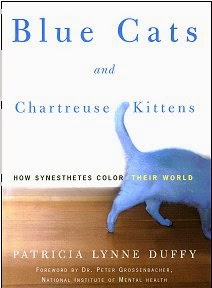
There are many different points of view regarding the causes and reasons for synaesthesia.  One of the best accounts of research into synaesthesia is a book called The Man Who Tasted Shapes by Richard E Cytowic. First published in 1993, this was perhaps the first popular account of synaesthesia making many people with synaesthesia more aware of their own experiences. One synesthete (a person with synaesthesia), who has beautifully described her own experience, is Patircia Duffy in her book entitled Blue Cats and Chartreuse Kittens. Organisations now exist dedicated to the further understanding of synaesthesia: e. g.  The Artecitta Foundation, The American SynesthesiaAssociation and The UK Synaesthesia Association.


Synaesthesia can tell us about the brain, the mind and consciousness. There are phenomenal people whose brains function in unique ways in combination with synaesthesia: e.g. Jason Padgett sees mathematical patterns everywhere he goes and the shapes Daniel Tammet sees for numbers, letters and concepts have helped him break the bank in a Las Vegas casino and learn Icelandic in a day.  As our science and humanity develop we may have an opportunity to self evolve and begin making decisions about what kind of animals we really want to be.

It is possible that some of the knowledge we are gaining through research into conditions such as synaesthesia will help us tap into some of the most amazing possibilities of the human brain. May we also not forget to appreciate the unexpected and inexplicable oddities of conscious awareness.  


Friday, 4 October 2013

Lifetime: What is a lifetime; how long could it be?


In a documentary called Lifetime,  Michio Kaku asks us, if given the chance,  whether we would drink of the elixir of eternal youth and live forever, or not? Kaku explores memory and the always-present awareness of each of our inevitable deaths.  Time defines the way we live and how we live defines how we experience time. “What would it mean to be immortal?” Kaku asks us.

Time is incessantly changing us. When we are young many of us feel immortal but as we get older we become more and more aware of how time is leading us towards the exit door; time will run out for us. “But why does time have to run out, why can’t we just go on forever?” enquires Kaku. The great gods who have been envisioned in our form by almost every culture are immortal; we have always dreamed of acquiring immortality for ourselves.  A fundamental aspect of the way that we exist today, however, is that we will only exist for a short time. We know that others have existed before us and hope still more will follow. We live much longer than many other creatures and most animals seem to have a set, programmed lifespans.  But, it appears, that not even our species is immortal. We have not been around for that long in the greater scheme of things and we have witnessed the extinctions of many great  species.  We suspect that the human race itself will one day cease to exist, as will our beloved Earth.  The longest living organism known to man is the great basin bristlcone pine tree, over 5000 years old; about the age of written human history. The oldest humans alive barely make it over 100. Humans have always looked up at the stars with aspirations to explore beyond. But we now know that anything we could get to within our current human lifespan would be inhospitable. It seems quite clear that our solar system has no other hospitable environments for human life beyond Earth, unless we can figure out how to terraform Mars. The nearest stars that may have hospitable environments for our kind of life are more than a thousand light years away.  One solution to this problem is that generation after generation of people live, procreate and die in space whilst pioneering towards where we might discover something. Another is to live longer.


At the Buck Institute for Aging in San Francisco  California, Gordon Lithgo has extended the lives of worms that normally only live around twenty days to over 100 days by manipulating their genes. At Cambridge, theoretical scientist Aubrey de Grey, at the Sens Research Foundation,   believes that we could beat the aging process even reversing it, making old age a much less common cause of death, possibly allowing humans to live for thousands of years.  Obviously there is more than living for a very long time to exploring the universe beyond Earth but having more time could definitely help. I imagine that Parliament Funkadelic’s Starchild, who travelled the universe delivery holy funk, must have had to live for thousands of years to get from place to place.  


Saturday, 28 September 2013

Mothership Connections: Parliament Funkadelic delivers the holy funk; Earth is a space station.


In 1976 Parliament Funkadelic, under its Parliament label, released the album Mothership Connection containing the single Mothership Connection (Starchild). The album is one of the most influential of its time having had a huge impact on jazz, dance, pop, hip-hop, R&B, Soul etc, and has been heavily sampled: Dr Dre’s Let Me Ride, is made up primarily of samples from Mothership Connection

The main man behind Mothership Connection, Starchild and Parliament Funkadelic, George Clinton, is also very willing to recognise his influences. Starchild, Clinton acknowledges, was inspired partly in the mythology of the music of Sun Ra. Sun Ra was an experimental Jazz musician and is well known for his phrase “Space is the Place”. He believed that music had immense power to influence humankind and potentially connect us with life beyond our planet. 
George Clinton’s Starchild, like Sun Ra’s black Noah, is a pioneer of Outer Space and a divine alien being. Starchild came to earth from space creating the Mothership Connection (the moment when Starchild and humanity meet) and bringing the holy Funk. The Holy Funk, with a capital F, is the cause of creation and energy source for all life. Starchild works for the intergalactic master of outer space Funk, Dr Funkenstein.  Starchild has a bop gun which he uses to create "Funkentelechy", delivering funk around the universe. Through much funk the mythology of Starchild evolves. He battles Sir Nose D’Voidoffunk and  tthe Placebo Syndrome, nearly loosing until he reveals the "Big Bang Theory", letting us know that Funk created the entire universe.

So all things are funk. I have always loved the idea that the universe began with music. Maybe the big bang was like a funk note plucked off of Bootsie’s space bass.

The idea of a divine alien funkster travelling the universe delivering funk appeals to me greatly. Let him come to Earth and share his glory. Perhaps, however, we musn’t wait around for the delivery of holy Funk, Maybe it is us that must go out into the universe with our funky music to share wherever we may. Some of Funkadelic’s line’s have been life long anthems of mine: I got a thing… You got thing, Everybody’s got a thing, when we get together doin’ our thing, get up to help each other, get up to help another. To be truly free is to be free from the need to be free.

William Burgoughs spoke of Earth being a space station at the intro to his album of spoken poetry with music, Dead City Radio. In "William's Welcome (What Are You Here For?)" with  music by LennyPickett featuring Sonic Youth, he pronounces:

“What are you here for?
We're all here to go
We're all here…. to go

Earth is going to be a space station
We're all here to go into space
That's what were here for…”